Fonts, Tablature, SVG, and a Demo
This was a pretty productive weekend. I got a lot working, and a lot to show off.
First, a credit to Simon Tatham, who created the awesome Gonville font, which I use for the renderer. Before finding Gonville, I tried to draw many of the glyphs myself and suffice to say, it didn't work out too well.
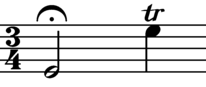
Gonville by Simon Tatham
Thank you Simon for creating this brilliant work of art!
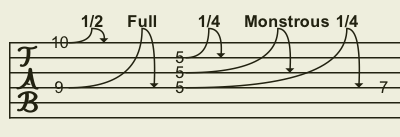
This week was all about the tablature. First, I added support for bend-and-release.
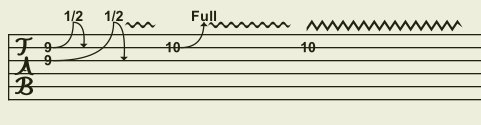
Then, I added support for soft and harsh vibratos.
I added support for custom note annotations.
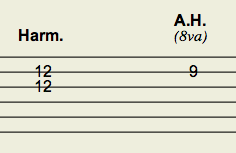
There are a lot of things you can do with note annotations.
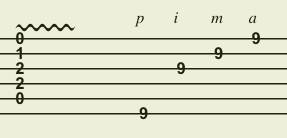
I also added full support for SVG. Yep, full support. With a little help from raphael.js, it was actually pretty straightforward to implement. I created a RaphaelContext class that implements the HTML5 Canvas API, and delegates all the drawing calls to Raphael. So now, the library uses HTML5 Canvas by default, unless you explicitly include the Raphael JavaScript library in your script sources.
I created the beginnings of simple tablature language to render guitar tab. It's called VexTab and it's very very alpha. Here's an example:
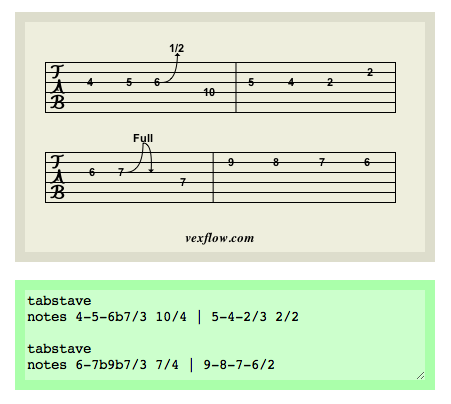
Anyhow, all this while you've been seeing screenshots of rendered notation, and no real HTML5-based demos. So, this time, I put up a new demo. All JavaScript. All SVG. Here it is:
A VexFlow Demo: The VexTab Tutorial Page
Hope you like it, and keep those comments coming.
19 comments (imported from blogger)
I converted the TTF to point-codes that the renderer can use. It is essentially converted into a bunch of MoveTo, LineTo, BeizerCurve instructions.
Re: ascii tabs, sure that would be simple. I'll let someone else do it after I expose the renderer API.
Ah, smart thinking for the font.
If your going to let others work on parsing ascii tabs and other importing, why create another text based intermediate to your api? or is that what you are rendering from directly?
Because it's really really hard to edit ASCII tabs. Try inserting a note in the middle of a bar, and you'll see what I mean. ;-)
totally agree with that, ascii is a real pain. What I was wondering was if the shorthand (VexTab) you created is directly what you are rendering from or is there a more formal data format/structure behind it?
Nope, VexTab is not an intermediary language, and isn't meant to be. The VexTab parser uses the VexFlow (which is what I call the renderer) API to generate the notation.
For parsing alternate formats, all you need is the API, which could be likened to a compiler backend.
Awesome work. Your rendering is clean and well done. And also your coding style seems to be great. Your project inspired me to create a similar project. I'm the developer of GuitarSharp, a C#.net GuitarPro renderer/player. I ported my application into Javascript/HTML5. Check it out at: http://project.coderline.net/jsguitarsharp/
Under which license will you release this library? Probably we can work together to create a full featured web-notation "software". Feel free to contact me.
Greetings
Danielku15
A few questions: How easy would it be to produce a stave for 5 strings (banjo)? Also, I didn't see how you produce multiple notes at the same time, even though I see an example in your post.
@Simon You Rock!
@Andrew and @AnswerGuru: I just added Step 6 to the demo that shows you how to do chords.
Can you show us how to do annotations in the demo?
And have you planned for adding hammers, pulls and slides? I'd think that something like 0h2s5p2p0/4 would work nicely.
And will the tab notation be compatible with the music notation/rendering?
Those are the logos which Blair has designed:
http://project.coderline.net/vextab/vextab_logo.pdf
i started a job wich i don't know were i'm going to end and arrived here trough google.
I have a series of images wich i want to highlight respectively on each note from a tablature.
So each image will come up as it's linked note will play, like the "Do" on image 1 and the "Re" on image 2 and so on.
Can anybody give me a hint.
Sincerely, Pascal
info@pascaldigitall.be
can u share me how u convert the TTF into GlyphJson and fit to the renderer?
OMG.. are them all with your own tools?